
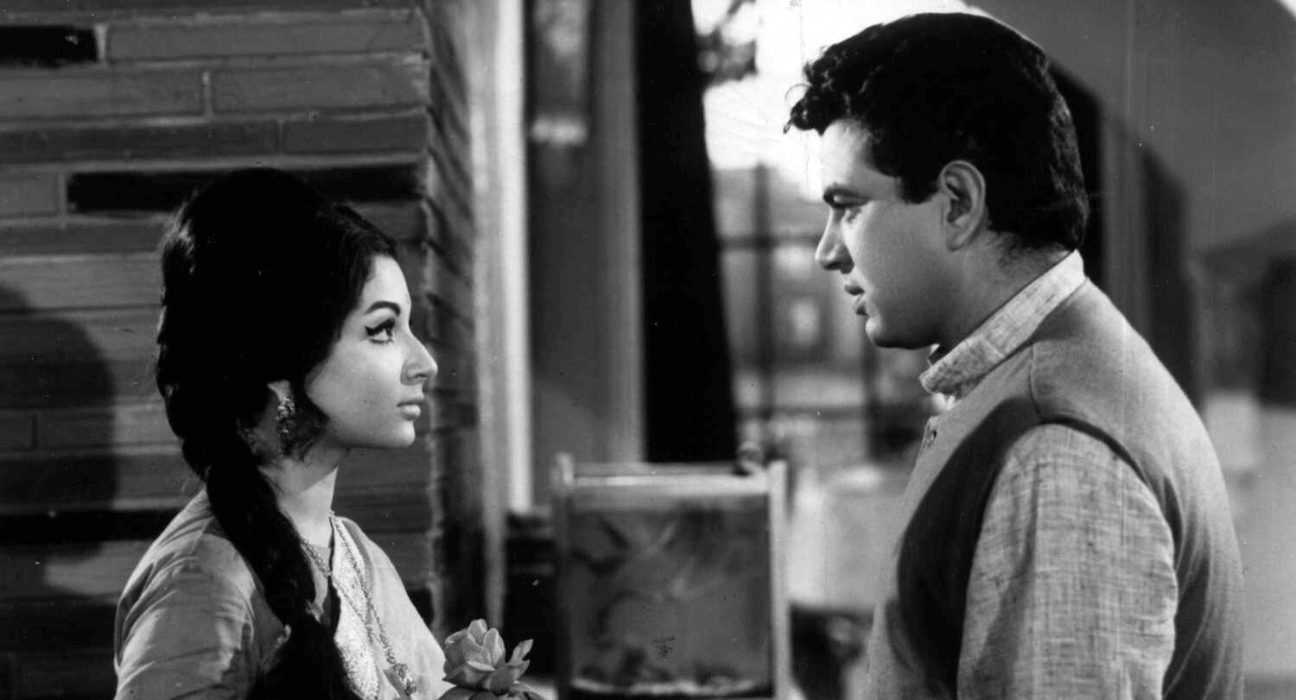
“Anupama,” a cinematic gem from 1966 directed by the masterful Hrishikesh Mukherjee. The film takes us on an emotional journey delving into the complexities of a father-daughter relationship. It stars the charismatic Dharmendra and the enchanting Sharmila Tagore. The supporting cast consists of Shashikala, Deven Verma, Surekha Pandit, and Tarun Bose. The film weaves a sensitive tale that humanizes the flaws within these familial bonds.
The film received widespread acclaim for its sensitivity and realism. Anupama earned the prestigious National Film Award for Best Feature Film in Hindi at the 1966 National Film Awards. Additionally, it garnered four Filmfare Award nominations, clinching the Best Cinematography, B&W category.
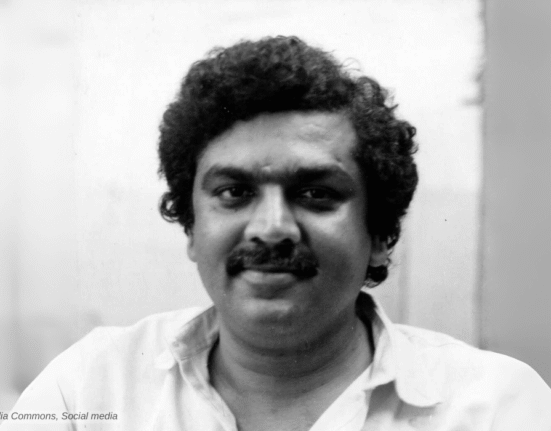
Hrishikesh Mukherjee—The Master Craftsman

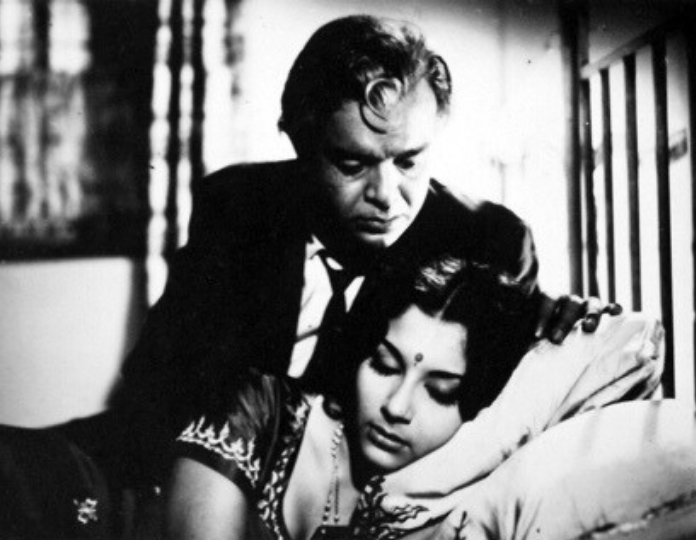
“Anupama” stands out in Indian cinema for its rare exploration of the intricacies of a father-daughter relationship. Tarun Bose delivers a compelling performance as Mohan Sharma, the father, while Sharmila Tagore beautifully portrays the daughter, Uma. Mukherjee’s directorial prowess shines as he navigates the emotional landscape, making it a poignant and thought-provoking cinematic experience.
Dharmendra steps into the frame as Ashok, a modest but straightforward writer whose gentle persistence chips away at isolation. This role, one of his early standouts, reveals the actor’s knack for subtlety long before his action-hero fame took hold. Mukherjee crafts a tale where words—and silences—carry the weight, and Dharmendra navigates it with a poise that lingers.
The Story Of Anupama
The story centers on Uma, played by Sharmila Tagore, a young woman haunted by her father’s unresolved sorrow after her mother’s death in childbirth. At 21, Tagore brings a fresh intensity to the part, relying on subtle gestures and expressive glances to convey layers of quiet suffering. Mukherjee saw her eyes as perfect for Uma’s unspoken pleas. This performance, blending restraint with raw insight into a daughter’s silenced world, marks an early peak in Tagore’s career. Tarun Bose embodies the grieving Mohan Sharma, whose alcoholism and bitterness trap Uma in emotional exile.
Enter Ashok, friend to Uma’s family friend Arun (Deven Verma). Ashok arrives from abroad, jobless yet principled, supporting his widowed mother and sister on meager earnings. He spots Uma’s hidden spark amid her withdrawal and draws her out through shared books and unspoken understanding. Their bond unfolds, challenging Uma to claim her voice while Ashok pens a novel inspired by her resilience. The narrative builds to a tender resolution, underscoring empathy’s quiet power over dramatic upheaval.
Sharmila Tagore as Uma (Anupama)
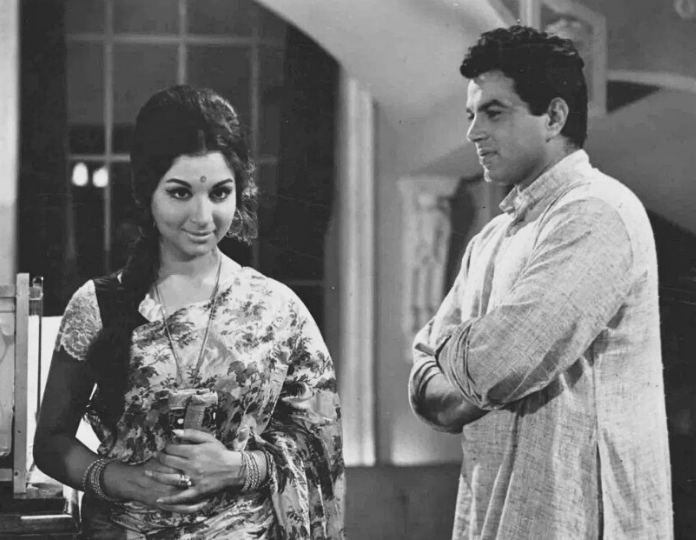
The core challenge of Sharmila Tagore was that Uma speaks barely five lines across 155 minutes, her voice emerging only midway amid a rare moment of familial warmth. She communicates volumes through body language—hunched shoulders in Mohan’s presence signal ingrained fear, while fleeting smiles during solitary walks in nature hint at buried joy. Her eyes, often mascara-lined and wide, shift from haunted confusion in childhood flashbacks to shy expectancy in Ashok’s company, capturing the “magical, hypnotic” gaze Mukherjee prized. In one standout sequence, Uma reads Ashok’s manuscript, Anupama—a tale mirroring her own—her fingers tracing pages as subtle hope flickers across her face, a non-verbal bridge to self-recognition.

Performances
Dharmendra brings Ashok to life with an effortless authenticity that grounds the film’s introspective tone. He moves through scenes in threadbare singlets and simple kurtas, embodying a struggling idealist who values integrity over stability. Watch him coax Uma’s first words from her lips—a pivotal moment where his patient gaze and soft encouragement unlock her guarded heart. Or note the scenes where he talks with Uma, his voice cracking just enough to convey vulnerability without excess. Ashok’s “we are poor but happy” monologue rings true, delivered with a wry smile that hints at hard-won contentment.
Dharmendra tempers his natural charisma here, letting restraint amplify the character’s poetic soul. He sings with a Hemant Kumar-like warmth, adding layers to Ashok’s role as both enabler and equal. His Ashok endures as a blueprint for understated heroism in Mukherjee’s humanism-driven cinema. It reminds us that true pull comes not from grand gestures, but from seeing someone fully—and acting on it.
Tarun Bose conveys quiet devastation through subtle tremors in his voice and averted gazes, making the character’s alcoholism feel like a symptom of deeper isolation. His final scene, blessing Uma from afar, captures pride’s painful grip with understated power. Shashikala plays vivacious Anita, aka Annie, the stark opposite of Uma. She infuses the role with bubbly energy, using rapid-fire dialogue and expressive shrugs to spark comic sparks. Critics note her cheer as occasionally overplayed, yet it effectively contrasts the film’s somber tones. Deven Verma’s confused charm shines in awkward family dinners, blending earnestness with light humor to humanize the romantic subplot. The chemistry with Shashikala elevates their pairing into a breezy counterpoint.
David takes on Moses, Mohan’s jovial friend. He delivers comic relief through exaggerated tales and dance flourishes, his booming laugh punctuating tense moments. As a Mukherjee regular, he nails the avuncular mentor with effortless timing.
What Make It Unique
Although Anupama is primarily the story of a father and daughter, it’s anchored by Dharmendra’s character. Years later, Aditya Chopra used the central idea of Anupama in his “Dilwale Dulahniya Le Jayenge,” with a tadka of NRI sentiments and new-age romance. But the core remains the same: a father’s acceptance of the daughter’s choices and happiness. Although Ashok is more humane, principled, and, of course, much more handsome than Raj.
Mukherjee’s delicate plot was enhanced by Bimal Dutta and DN Mukherjee’s screenplay. Rajinder Singh Bedi’s powerful dialogue and Kaifi Azmi’s lyrics gave the film immense depth. Hemant Kumar’s timeless music had musical jewels like Dheere Dheere Machal, Kuch Dil Ne Kaha…Kuch Bhi Nahin, Bheegi Bheegi Faza, Kyon Mujhe Itni Khushi De Di, and Ya Dil Ki Suno Duniyawalon, the last picturized on a kurta-pyjama-clad Dharmendra, a picture of scholarly dignity.
Mukherjee dedicated Anupama to Bimal Roy, and its slight resemblance to Sujata is discernible. Audiences then had the patience and ability to appreciate a film that was tender and refined in its narrative and left a lot for the viewer to interpret for themselves. Today that style of filmmaking has been lost, maybe forever.
Anupama on IMDB